
It was an interesting sound.
Sometimes, no matter how much training you might have in any given area, you still make a potentially egregious error. It happens. This was one of those well-intentioned moments for me. I had the knowledge, the skills, the tools, the resources, and the… Well… I had the ignorance.
Now, ignorance can be bad. Sometimes. However, it can also be good. If you don’t know it ‘can’t’ be done, that’s often when it gets done. Many great inventions have been created because nobody told the inventor it couldn’t be done. Many times, a thing was invented because someone told them it couldn’t be done. So, they did it.
This project—for me—all began with a basic idea: Portable, affordable, flamethrower.
Not everyone can afford a flamethrower. Also, the fuel for one would also cost a lot—over time. I had a better idea. A smaller, portable, economical flamethrower. See, Uncle Sam was offering me multiple food packages—M.R.E.s. And sometimes, I would not use the heating sleeves. I would just eat the main meal cold or ‘room temperature’, as it were. Those heater sleeves, then, would come home with me for other activities. Like, blowing up snowmen, or keeping people up at night—on accident.
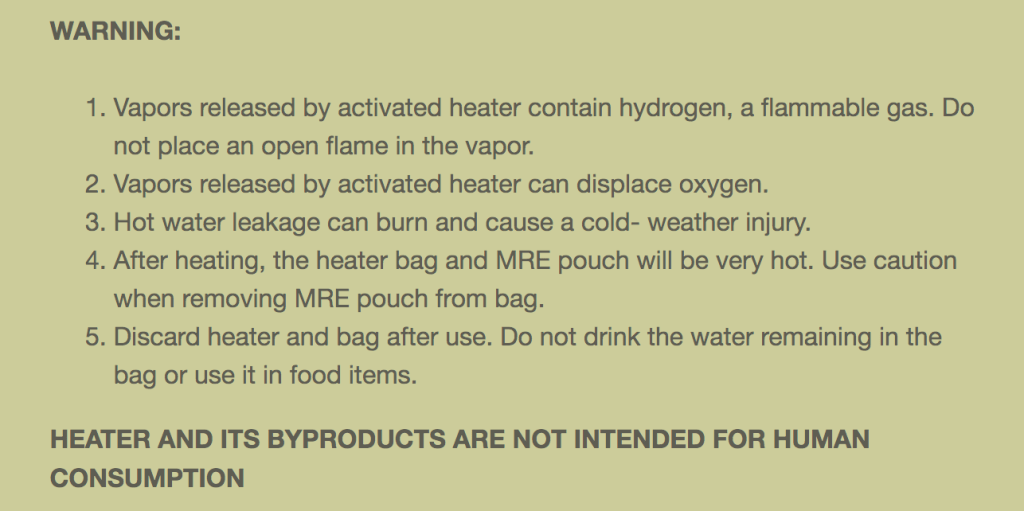
From experience, I knew the gases from the heater sleeve were flammable. Don’t ask me to recall how I know. I just do (see below). Marines do things—with stuff. So, I thought, if I could control the amount of flow and pressure, I could have a small portable flamethrower. I just needed the right parts. I would need some flexible tubing, a nozzle, and a container for the chemical reaction. At least.
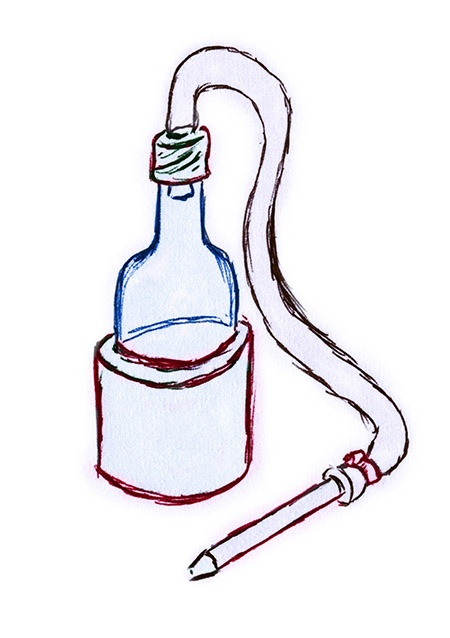
From experience, I knew that the heat from the chemical reaction of the heater chemicals and water would melt a plastic bottle, so glass was preferred. A threaded cap would be best, so as to not blow off from a pressure buildup. The tubing would need to be sturdy, flexible, and heat-tolerable (I know what I wrote). I happen to have several spools of excess surgical tubing from my summer job at the local Scout Camp (don’t ask why). I also would need a ‘handle’ of a sorts and a tip for the gases to come out of.
Those last two, I knew, would require being adjusted to conditional circumstances. The handle would be what I could find that could attach to the afore-mentioned surgical tubing. The tip—the more I thought about it—needed to be metal, and be able to attach to the also afore-mentioned handle. So, which came first, the chicken or the egg? The chicken. Duh.
The handle ended up being a plastic pen shaft made of sturdy plastic. The tip, or nozzle, was a metal pen tip that could be threaded into the pen shaft. That made it easy. I had a few of those kinds of threaded pen shafts of sturdy plastic and metal pen tips lying about my ‘project table’. Now, I had all the parts. Time to construct the flamethrower.
As I write this, I realise that I did not really clarify how I intended to use this flamethrower. So, I should do that. I’m gonna do that. Here I go, doing that: The flamethrower I was building was for small craft projects that needed concentrated, continual heat on a small scale. I couldn’t just light matchstick after matchstick after matchstick (tried it, it doesn’t work well, and fingertips get burnt). Or just use a basic lighter (the flame isn’t directable—that matters sometimes). I had tried several things, and none of them were effective in what I needed them to do. I needed this idea—and for it to work. It was going to work. I just knew it.
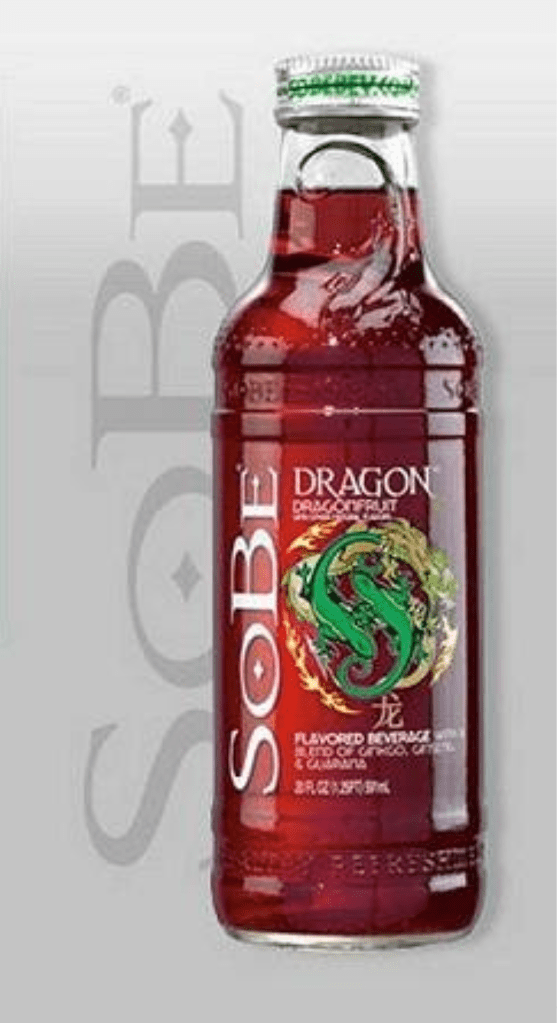
Many years ago, the product Sobe used glass bottles with metal threaded lids. It was a good size. The metal lid would not soften or warp from the heat, and it was threaded, which provided everything I needed. Additionally, as I talked about this project with my wife, the idea of the bottle getting super hot and not able to be grabbed by me to be moved, or whatever… It would need insulation. Good point. Neoprene sleeve for a can.
I’m sure many of you have seen them, the neoprene sleeves for cans. When I was a child, my buddy’s dad would put his beer in one when he came home from work. That was the first time I ever saw one—and that was back in the ‘80s. Just a simple insulating neoprene sleeve. The Sobe bottle was about the same size as a standard soda can and fit right into one of those sleeves. Problem solved.
I drilled a hole in the lid, smaller than the surgical tubing—so as to help lodge it into place. I considered trying to ‘lock’ the hose into place, but that only collapsed the opening and stopped up the ‘valve’ of the hose. However, the method I used worked out well because now there was a fail-safe built into the system. Wonderful.
Next, I figured out about how much hose I needed so as to allow most of the gases to leave while still maintaining pressure for the gases to leave the bottle, yet still allow me to move the end about to aim the flame. After that, I shoved the pen shaft into the hose, deep enough that a pressure buildup wouldn’t pop the shaft or hose free. Additionally, I placed two zipties clamped tightly about the shaft to ensure it not being blown out. The bottle was about the standard size I used to ration a full MRE heater sleeve with a known amount of water. This was going to work.
Now, all I needed was an opportunity to use it. Yeah, I used the word ‘use’. Not ‘test’. Why test it? I knew it would work. I’m not stupid.
Just sometimes ignorant.
The moment came. I do not recall what it was that I was going to heat up. What I do recall, vividly, is what happened. The moment IT happened. No, not the Stephen King It. My IT, the moment of IT. That IT. Okay, that was an unnecessary tangent. But, if you’ve ever read this blog, you know that I do that. Anyway…
I took the project and my flamethrower out my front door and onto the sort-of-driveway-gravel-lawn area that was the front of our rental property. And, as any good horror moment requires, it was at night. In the dark. I was alone. Insert facepalm emoji here.
So, there I was, in my driveway, playing with matches… I had added the MRE heater material. I added the correct amount of water (again, a measurement I had come to know well). The gases began to pour out. Hot. Fast. Strong. I lit the match to ignite the fumes.
You might know someone who can do this. Or, you might be someone who can do this. You just know a thing by the sound of it. Like a really good mechanic can hear what’s wrong with your car’s engine. I knew of a guy who could balance a tire just by spinning it. Nothing else. He knew by feel and sound. Sometimes we do a thing so often, or so well, that we know it like we know our own self. That’s why the sound I heard a few moments later upset me so much.
There is a specific sound made when firing an M203 grenade from an M203 Grenade Launcher. It is similar to a vacuum tube activating—the kind used to send documents to other departments in large buildings or at banks at drive-up teller windows—but not quite the same. The sound, if written, is “Thoomp”. That’s it. The explosion sound is not that sound. That thoomp sound is the sound of the grenade launching out of the tube—or barrel. It is a distinctive sound known to those who have used an M203 Grenade Launcher enough. I know that sound. It is the sound of impending doom.
I lit the match. The gases ignited and did a curious thing. Within that small length of flame, I was seeing reds and blues and greens. Clearly. Distinctly. That flame had some heat to it. Nice. This was going to be good. I began to heat my project and use the different hot zones of flame to adjust and shape whatever it was I was making. It was only then that I realized I didn’t have an ‘off’ switch. But that was fine, as I knew about how long the gases would last. I had, after all, eaten enough MREs to know how long the gases would gas.
(I know what I wrote)
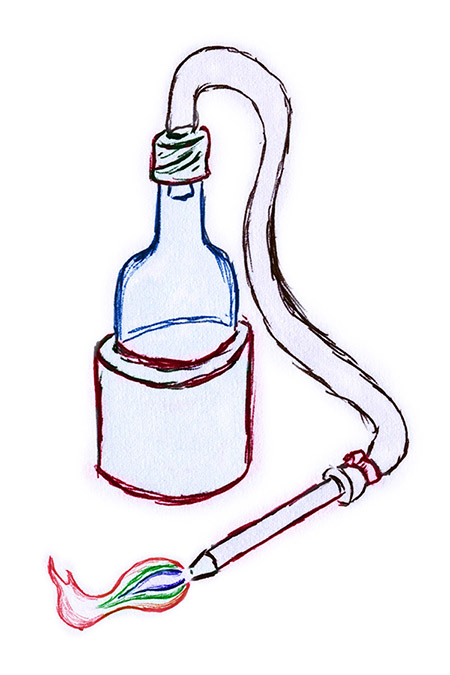
Then, it happened. The sound. The sound like another I knew so well. Not quite IT, but close enough that it could have been a paternal twin. It froze me.
POOMF!!!
Panic shot through my form, and I was frozen and awaiting the glass shrapnel that was to follow. I knew instantly what had just occurred.
In the split second that it took for me to process the “POOMF!!!” sound, I knew what was coming and began to plan on what to do to not only explain to my wife the why I was impaled by dozens of bits of glass, but also how to remove said dozens of bits of glass from my left-rear, well.. uh, rear. The bottle was at my 7:00 position and low to the ground—like I was.
Since that moment, I have had a few circumstances that have helped me understand a few things. One involved a gasoline can and what I was told was diesel fuel. I had thought that the size of the nozzle I had used was small enough, that when the pressure went low enough, and given the internal diameter of the hose, that there would be no backdraft. That any flame would be choked out within the confines of the hose. I was wrong. SO wrong.
Where were we? Oh, yes: POOMF!!!
A sound I knew too well. The sound was made; now would come the shrapnel. Now would come the shrapnel… The shrapnel… All that shrapnel… Where was the shrapnel?
I tentatively turned around—mostly because if the shrapnel were to still arrive, I didn’t want it in the eyeballs—and there was my bottle: Still intact. The hose: Still intact. What…? What went “Poomf”? What made that sound? Then, I found it. The hose. The safety I had accidentally built into the system, where the hose was tight in the threaded cap, had worked. While the internal diameter of the surgical tubing did nothing to smother the fire that clung to the gases as the pressure dwindled, that safety kept it all from going to pieces (literally) and into my backside.
As the fire rode its way backward, inside the hose, to the source, once there, the flaming force attempted to burst its way to freedom, but only just popped the hose out of the metal cap. All was intact—except my pride. That poomf was so close to the well-known thoomp, my training and education kicked in, and I just expected an explosion and shrapnel. Hooray for safeties—accidental or otherwise. And a little looking over from a higher power.

 Almost Heroes