
Last Fall Season, I had an idea: Dual Wield.
So, I have a flat roof. I have a flat roof with solar panels. Leaves and small bits of debris can get stuck under said panels. To help get the stuff out from under them, I use an electric leaf blower (because that is what I have, and I prefer it over a gas motor option). I drag an extension cord up to the roof—no big deal—along with the leaf blower. Then, I proceed to work my way back and forth in an attempt to remove the detritus from under my solar panels. It takes a long time to get the gunk out.
I have to walk back and forth to get all of that stuff. The first pass loosens it up. The second pass gets some more bits loose and blows portions of it out. Then rinse and repeat until done. After this past present season was over (I know what I wrote), was when I had the idea: Dual Wield leaf blowers! So, I spent a year figuring out, shopping for, and collecting the parts I needed to make it work. A splitter and a couple of short (the right kind of short. ten-foot short) extension cords.
This year, I did it. And it was great.
Usually, with just one leaf blower I would need to switch arms to help with the weight—as one arm would get tired. Also, sometimes when I would blow into an certain angle, the leaves would just come right back at me. Then, there is the fun oddity that the leaf blowers have different nozzle lengths and the ends taper differently as well. So many little things that made using just one of my two blowers a mild hassle. While it was still nice to use a leaf blower and not have to rake the whole yard, the two different blowers manifested unique challenges.
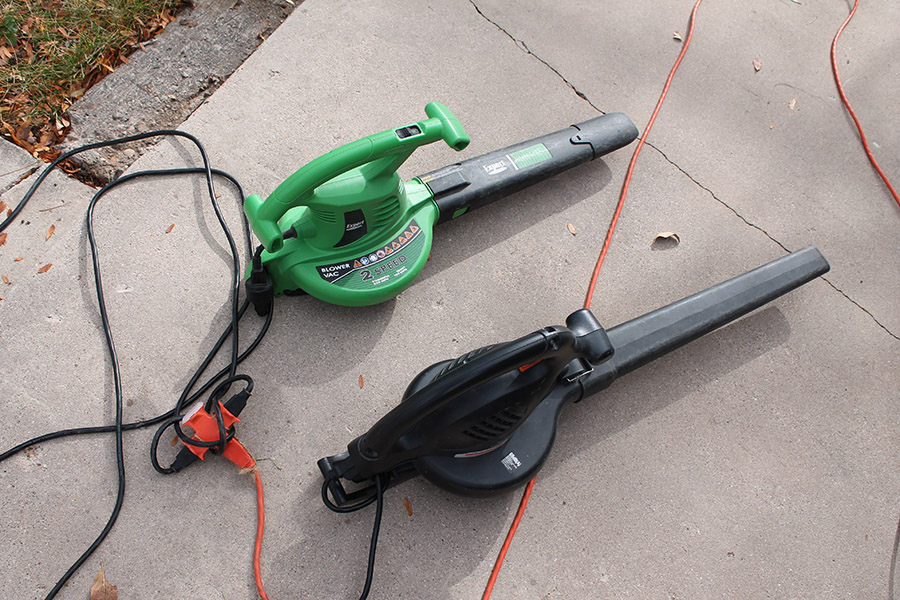
With the two blowers connected—and an adjustable plan in mind, I began the job. First, I started on the roof. With the solar panels set the way they are, I need to blast the debris collection out from under them. With one blower, I would spend too much time going back and forth trying to get the gunk out. If I blew one way, the stuff would double back on the breeze and I just moved around a lot not accomplishing much. With two blowers, I could set one in place to get the general direction breeze a goin’ and then move along with the other blower and get most of the waste out from under the panel in very little time. Sure, there was still some back and forth. But, a new plan takes time to work out the kinks, and the whole process still took less time than before.
Once on the ground, I had figured things out a bit better. I used those two leaf blowers like a Samurai warrior that my Japanese ancestors—who I more than likely do not have—would have done. The larger one (the Katana) was in my right hand. It has a longer nozzle with a wider opening. This would be used to strike first and push back the first waves of leafy ground troops. The second—and smaller—leaf blower was my support. Like the Wakizashi, I used it to maneuver the leaves in the smaller areas of my landscape that proved too difficult for the Katana.
In a battle sequence that would compare to nothing like the legendary Miyamoto Musashi (a Samurai famous for his unique double-bladed sword techniques in feudal Japan. he wielded a Katana and Wakizashi simultaneously for maximum advantage during battle) I began to move about my backyard like an ‘80s child—who watched too much Kung Fu Theater—would have imaged a ninja master (I know what I wrote) might have done to extinguish the oncoming hordes of leaf-like ground invaders. And it worked.
With one hand I would cut a swath of high-powered air at the front lines. This would kick up insurgents and those who wished to attempt sneak attacks or high-jump aerial assaults. Those would be assassins would be deflected by my second ‘blade’ as it swept about the area after the main blower had moved on. The new technique was working quite well. Leaves moved about quickly and easily.
So far, so good.
Now, my next move (which I have perfected over the years) I prefer to call Parting the Red Sea. Or, The Moses Manuvere. It’s pretty straightforward. When the leaves begin to build up into a heaping barrier, they become harder to blow away—too much weight. So, you can either blow the top layer off and work your way down, basically moving the wall of leaves a little bit at a time. That’s no good and doesn’t always work. This is where Parting the Red Sea comes in.
You aim the nozzle of the leaf blower near the base of the leaf pile, holding the machine at about a 45° angle. This creates a small pocket of air that will subtly begin to lift a portion of the pile. Reading that last bit sounds a tad gross. Yeah, so, potty jokes are still funny at my almost 50 year age. I don’t care. I still giggled. A-anyway… Moving on…
With that pocket of air created, you move the nozzle forward and lift the angle just slightly. That pocket makes a weak spot in the overall lump of leaves. Once this occurs just continue to shift the angle of the leaf blower and suddenly there is a small path being cut right through that barrier of dead tree detritus. Those leaves just fly up and to the sides and then you are free to do it again at each side of this miniature pathway. Everything just gets caught up in that Charlton Heaston reenactment and goes with the flow. It works every time. (for me, at least)
As a Dual Wield, this seasonal scene was even easier. As soon as I began to part the sea, I moved in with the other blower. With that support, stuff just went every which way (in the directions I wanted). Suddenly, I was combining my Wakizashi tricks with my Katana sweeps with my Red Sea moves and the leaves just drifted away. I was done in almost half the typical time. I use ‘almost half the typical time’ because it was over half the time but less than three-quarters of the time. And most definitely shorter than 2/3rds the time—probably. My point is that the entire endeavor used up less of my day than has been customary and I wasn’t as irritated as I usually get due to my having to go back and redo an area because the leaves were redoubled back toward me due to structural situations.
It was nice.
I have a plan to improve the Dual Wield for next year. A few times the triple outlet that I hooked on the end of my extension cord popped off. While I had secured it with a break-away cord (ya’ gotta think about safety), it broke too often for my liking. Hardware does exist to ensure it will stay without creating a safety issue. And, all that is fine. This year was the test run, after all.

 Almost Heroes