
There’s an old saying that the captain goes down with the ship—ours did.
At this point in my mind, many of the insignificant details have been lost to time. When I use the word ‘insignificant’ I do not mean to apply a label of uselessness or indifference to those details. No. Not at all. What I specifically mean is that those details do not shape the end result. They do not interfere with how events played out. They are details that have faded into the background information that is part of the story, but not key to how things ended up. Because if someone was on the right or the left side of a thing, it wouldn’t change the fact that they were present. So—for the most part—I will state this story as though this is exactly the way it happened.
Besides, you weren’t there. How would you know otherwise?
There is a magical place on the West Coast where all your amphibious dreams can come true—even the ones you never knew you had (because you never knew you had them): Navel Base Coronado. This was either my first or second Annual Training with my Marine Corps. It was the same one where Lewis inducted me into his Fire Team. There were lots of water-related activities planned for us.
One of my favorite memories of these events was the Zodiac Boat races. We had spent—I think a few days—getting used to positions, commands, and some basic uses of the Z-Boat (transportation, beach assaults, night ops… you know? the basics). Nearing the end of this section of our training was a race day. It was quite simple: Each boat, and its crew, would row out to a buoy, turn, pass the buoy, and head back to shore. Kinda like when you were in gym class and the P.E. teacher told you to run to the wall, touch it, and run back as fast as you could. Except this was on water—for what are, I hope, obvious reasons.
However, we are Marines. Everything we do is with intensity. So, this cannot be just a timed race. No, it needs to be a competition. One boat crew against another. Whittle them down to a final victory to ensure that they have bragging rights for eternity. Because why do anything just for funsies? Right? Right.
A Fire Team consists of four Marines. The Z-Boat rowing crew consisted of six. That meant that many a Fire Team was split and shared amongst other teams. I was fortunate (or ‘un’, depending upon how you looked at it) to have my whole Fire Team. That was good. And the Squad Leader. Fine. He was a more than competent Marine—and a decent fellow. Oh yeah, and the Platoon Commander. Yes, you read that correctly. The Platoon Commander. My Platoon Commander. That meant that my rowing crew consisted of not only my direct leadership but his as well. Not to mention that guy who held all our careers directly in his hands: The Commander. The only one missing from my direct chain of command was the Platoon Sergeant. As a new Marine and especially as a new Marine to my unit, I was more than a little nervous about anything I might do to mess anything we did up. It didn’t help that I was in a position on the Z-Boat where everyone could watch my every move.
The boat crew had six positions. I was either #1 or #6 (depending upon if they counted up or down. recall that insignificant detail’ thing I mentioned before?). I’m going with #6. Our Platoon Sergeant, Sgt Kwiatkoski (or just ‘Ski’), was assigned the A-Coxswain position while the Platoon Commander, Cpt Mitchell, took the role of Coxswain.
A Coxswain is the one in charge of the boat. They are the Captain of the ship. Our Captain just happened to be an actual Captain. The common pronunciation for coxswain is /ˈkɒksən/ or KOK-sən. Basically, it is pronounced as cox’n, and will hitherto be referred to as such. I believe the Marine instructors had a title on the boat crew as an A-Cox’n. That was Sgt Ski’s billet. However, I have not found anything regarding a title like that. So, I imagine it referred to an ‘Assistant Cox’n’ as that is what the instructors said he was: “You’re the backup Captain in case your Captain is injured or dies.”
So, my spot was on the port side, the most forward position. I will never forget that. Ski and Mitchell were in the two most rear positions. One was on the port side, the other was on the starboard. What’s important is that they were at the aft of the boat. Lewis, my Team leader, was on the starboard side, middle position. I remember because when I looked over my right shoulder, his was the face I always saw. The Eternal Lance Corporal—of whom I have mentioned before—LCpl Stevens, was either to my starboard or directly behind me (between me and Ski). Then, there was one more body. I honestly do not recall who it was. I really wish I did (recall the ‘insignificant detail’?).
I know what I wrote.
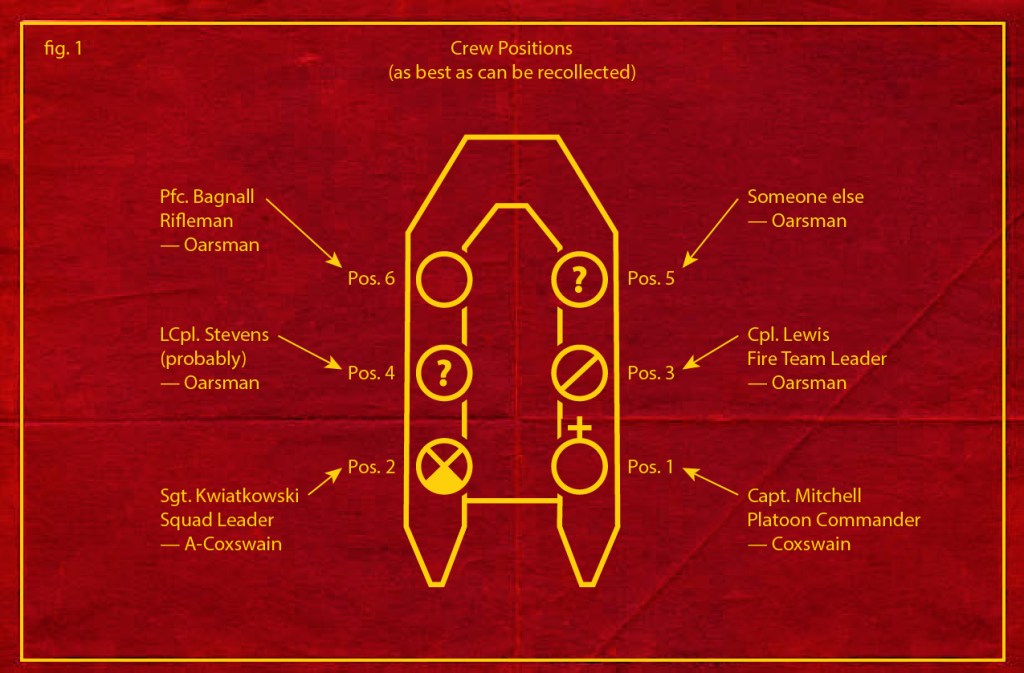
Anyways, as it came time for our crew to launch off against another, the Captain walked over and said, “We’re not gonna lose.” Yeah! That’s the spirit! Way to motivate us by reminding us that it is only by our will to win that we will… uh… oh… I totally misread his words. At first, I thought Mitchell was just trying to spur us on by reminding us that we are Marines. Marines don’t fail, and other such motivating stuff. Then, as I looked about the crew, read their body language and faces, I realized that what he was actually saying was, “I’m the Platoon Commander and I will not be made to look bad by being in a losing boat crew.” Tough guy. But, I learned to respect him, and I would like to think I earned the same—after a time. Remember, I was the new guy.
It was our turn. The Z-Boats were lined up. Front end facing the Pacific. The rules were simple: Stand by the boat (at attention), by your position. Row out to the buoy. Go around it. Return to the beach. Turn the boat back around to face the ocean. Every crew member must be standing (at attention) next to the boat at their assigned position. All oars in the boat. The first crew to do this wins.
“GO!”
Hands dropped to the ropes on the boat’s sides, we lifted, and were running as fast as we could into the salty blue. The first two bodies—when able—jumped into position and began prepping the oars for the remaining crew members. Each person sat astride the sides of the Z-Boat. While a zodiac boat can come in many different configurations, putting six bodies on these required us to straddle the inflated raft’s frame. It wasn’t long before everyone was onboard and we were rowing in tandem.
I don’t know why, but I believe Ski was the one shouting the “ROW!” command. Regardless if it was Ski or Mitchell, we had a good crew. Ski found a rhythm that we all could work with. He knew when to push us hard and when to ease off. He read the water pretty well. If we could get to the buoy first, we had a good chance of winning. See, the first one to the buoy got to go around it at a closer arc. Because the two boats started off on either side of the marker, each one would end up at the point on the beach where the other crew began. The last one to the buoy would have to row father out to maneuver around the other boat—if the two arrived at about the same time. In our race, both boats were pretty neck-and-neck. It was going to be close.
The other Zodiac made it to the turning point first—but only just. We almost rammed them full-on in our efforts to close the gap and make the turn before them. Not only did we now have to catch up, but we had to pass them as well.
During all the previous practice drills we had become aware that if you time it just right, you can ride the crest of a wave for an extended period of time. It requires centering yourself vertically while centering your position on the wave horizontally. This provides you maximum time on the wave to take advantage of its energies. If your strokes are at the correct speed, and the wave is wide enough, you can ride it almost back to shore. However, you still have to steer the correct course. Ski found us that wave.
We were not closing the gap quick enough. We were going to lose. Second place with the Captain on board was not an option. As best as we could, we maneuvered our craft. Ski providing commands of direction and oar strokes. We found our position on the wave and held it. I guess Posiden decided that a game—at our expense—was in order. Our boat subtly shifted and was now headed directly for our competitors’ starboard aft section. I cannot forget what happened next.
Right as we were about to make impact, the command “ROW!” was given. Our port bow was about to collide with their starboard aft section. I recall distinctly because it was going to be my leg that got crushed. Remember, each of us had one leg in the boat and one leg on the outside, in the water. I saw the timing in my mind’s eye. “ROW!” My oar came down as the ocean brought us together. I could not hold back. Three commanders would have seen my hesitation. There would be no explaining why I had to hold back. So, I didn’t.
Down came my oar, into the salty brine as our craft collided. My oar narrowly missing the leg of the Cox’n of the other Zodiac. However, it still hit home. It fell between the rubber rafts just as we hit. And, as physics kicked in to bounce the two rafts apart, my oar was almost ripped from my grasp. The blade had dipped in between—all the way to the shoulder—the other Zodiac and its outer rope that is used as a handle or gear attachment cable. We had accidentally become locked.
Now, for those who think I may have done it on purpose. I did not. Honest. The command to row was given. I followed orders with the rhythm of my team. The Pacific pushed us together. It was out of my hands. Almost.
With the rebound, my oar was almost pulled from me. I was attempting to yank the oar free, but the shoulder design made it tricky. Not to mention the fact that the boats were trying to go in two separate directions.
“Hey! No cheating! Let go!” Came the orders from the other cox’n. It was Peck. A normally jovial fellow, who was now angrily grabbing at my oar and ferociously trying to tear it from me.
“Bagnall! Don’t you dare let go!” Challenged the Captain and Ski. I could not let go. I am pretty sure that Lewis jokingly said something like, “Way to go, Bags!” Even though it was an accident. Still, I would not let go. I could not. I dare not. Three commanders watching me. My life and career would have been forfeit.
Finally, it popped free. The rowing continued. Our craft crested another wave. We caught the lead—but not by much. We hit the sand and everyone disembarked—with aggressive intensity. Those in front lifted and pulled. Those at the rear tried to find footing and keep up. Those in the middle did what they could. We were on the beach and turning. The other crew had landed and were moments behind. With all the zeal we could muster, we reached our literal turning point and began the rotation for completion. As we did, the Captain fell.
We almost didn’t notice. Ski did. “Back up! Back up! We ran over the Captain!” Mitchell was now accidentally inspecting the bottom for barnacles. We backed up. You don’t run over an officer without consequences.
As soon as his now sand-covered face was visible he yelled, “DON’T STOP! Keep going!” He was not going to have his pride tarnished because we reversed course in an attempt to save his dignity. Forward we went. Right over the Captain. As soon as there was clearance, Mitchell popped up from the beach, wet, and sandy, with bits of seaweed decorating his uniform like oceanic medals, and darted to his post—on the other side of where he was razed.
We had one. By fractions of a second. The other crew bemoaned and complained. And, when they argued that I had cheated by hooking their boat. The Captain just said, while clearing his mustache of sandy debris, “I didn’t see anything.” You don’t argue with your Captain.

 Almost Heroes