
Okay, this is going to generate some controversy (maybe, possibly. I might be overestimating my importance). Frankly, I don’t care. Since I started this blog, this has been one story that I have been just itching to write about. And, I think it’s finally time.
If you do a quick Google search (or just follow the link I provide you), you will find an article about the origins of Parkour. While this article does have correct elements in it, what it does not have is the truth. Sadly, the claim I am about to make is made over and over again, throughout history. There is always a, “I invented [this thingy]!” and then there is some other guy who didn’t get to the patent office first (but made the thingy first) and doesn’t have the clout, or money, or the right connections and says, “No, I did [it] first!” Fine. I know what I’m up against. I also know what I did. I invented Parkour.
Well, Erich and I did—and we didn’t call it that.
It was Superhero Training.
Unlike Marvel’s X-Men, I didn’t—and still don’t—have access to a Danger Room to practice and hone my superhero skills. Plus, there is only so much work you can do in your bedroom before your mother attempts to kill you because you are wrecking the place and it’s either death or go outside. Also, for reasons that I’m sure are real but remain uncollected (I know what I wrote), Erich and I didn’t do much training during the daytime. I would submit that it was due to the fact that we would train in costume (so we could find potential problems and fix them—both in our costumes and our movement) and we did not want to give away our secret identities.
Now, this is not about who did what first, or some sort of attempt at royalties or a sad grasp at fame (well, maybe just a smidgen of the latter), this is just the tale of how Parkour was invented in the United States, during the late ‘80s, not the ‘90s in France.
With all the park events (games and such), and The Park being what The Park was—a park, Erich and I figured that the best way to practice our skills was to practice our skills like children. (I know what I wrote)
Remember when you were a child and climbed like a wild animal all over the schoolyard jungle gym? Or spun around on the merry-go-round till somebody flew off—or threw up (either one was good fun)? This is how it all began for us—except, not the vomiting. We didn’t vomit. See, Erich and I both realized that The Park had all we needed to train like an X-Man or Avenger in an expensive, high-tech facility. The Park was perfect. Perfect.
It didn’t take long before we had multiple routes and a theme for our rules. Everything depended on two things: Us. Before the training began, each of us would pick a route—it could be the same or different—and then one would race while the other ran the timer and kept score. While we were not necessarily trying to beat each other’s score, we were also not not trying to beat the other’s score. It was both a competition while also remaining friendly. We would drive each other to do better and watch for ways to improve our technique.
The typical route would start at one end of a large play structure, you know the kind. The ones that have multiple ladders, fireman poles, slides, and other stuff all connected together. The largest one in our park had a ladder on one end and a large slide on the opposite. Also, the fireman pole was near the ladder. We would choose to either climb the pole (so very difficult to do and added hours to one’s time) or the ladder (done right, one reached the top before the timer finished the word, “Go.”). After the ascension, the person running the course could take the short slide, the long slide (which had a ‘ripple’ in it—for fun), or the curved ladder in order to reach the ground. No jumping. This was a skills-practicing opportunity.
With the slides, you could descend in any form you chose: On your butt (heh, heh… butt), head first, running (yeah, running), or whatever. We got pretty good at grabbing the safety rail that ran horizontally at the top of the slide and launching ourselves far out. Erich once launched so hard that he bypassed the entirety of the short slide and hit the dirt at the base of it—barely on his feet. He got better at that as time went on. With the curved ladder, the rule was that you had to walk it. Yup, you had to walk down the ladder rungs, on your feet, without handholds. The first few tries went horribly wrong. Horribly. Feet slipping, and then feeling gravity’s pull as you straddle a metal pole that continues to suspend you two feet above the ground. Then, after you hit (and make a sound of supersonic soprano proportions), you curl up, roll over, and hit your head on the ground because you’re unable to move your arms because your nervous system was disrupted mere seconds ago. So horribly wrong…
After the big set (we called it something like that, ‘The Big Set’ to identify it clearly), were the swings. They were fun. If everything went perfectly, you could run through them without getting hit. And, they could either be in motion or not (runner’s choice). So, you either dodged them while they were stationary, or the timer would set them in motion and you had to run in a straight line without the moving swings making contact. Always a challenge. Sometimes we would jump through them. Either in a high-step, like football players running through tire obstacles, or we would dive through them and do a tuck-and-roll. On the tuck-and-roll, if you hit a rock… Ouch. Occasionally, we tried to step from one swing to the next while only holding onto the swing’s chains. Since the swing seat was a flexible rubber, it would give when we stepped and make the whole endeavor ridiculously difficult.
Look, I said we invented Parkour (but we called it Superhero Training). I did not claim that we were exceptional at it.
These were almost always the first two obstacles. Once these were passed off, the rest were whatever we wanted. Usually, the next obstacle was called out before the current one was finished—in case the timer had to operate an event. One thing we would do was run through the merry-go-round while it was spinning. And I mean run though. You had to get out on the opposite side you entered. Had to. That said, if the timer super-spun the merry-go-round, the runner could easily get tripped up or pop off at the wrong end. Usually, it ended with the timer laughing at the runner as they fell all over that merry-go-round.
The center was a respite. You could pause, get your bearings, then make the dash to the part of the merry-go-round that would allow you to depart at the appointed location. You really had to watch for—and truly understand—the timing. A more valuable skill that I think most people do not believe to be all that valuable.
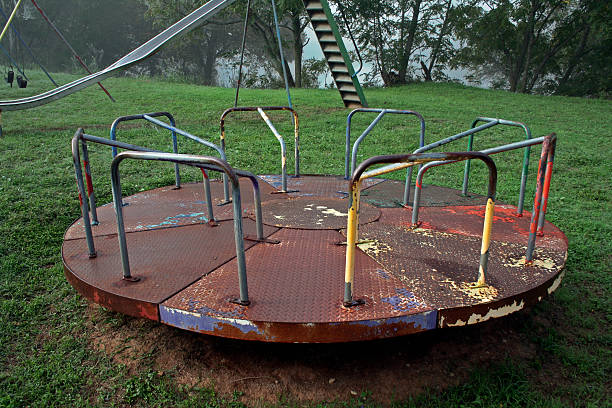
Photo curated at iStock.
We had two obstacles that were personal favorites of mine. One was a sideways curved balance beam. It was all metal, low to the ground, and curved like an ‘S’ would if it was almost fully straightened out. If you did the balance beam you had to do it right after a merry-go-round round. We had two to choose from. A large one located at the big kid portion of the park (see above) and a small one in the kiddie section of the park. That smaller one could get spinning fast enough to make a supercollider look like it was moving tree sap. So many G’s for such something so small… Ugh.
My other personal favorite was the Thunder Dome (1985, Mel Gibson, Tina Turner). I’m sure most of you have seen them. Those hemispherical metal-bar domes that children climb on, into, over, and through. And, that’s exactly what we did. Over it, in and out of it, through it… All we had to do was get through it. Usually, we had a set number of times we had to move in and out of it. Or, we would have a rule like: You have to exit at a different elevation than what you entered in at. Meaning that if you entered at ground level, you had to exit at the top. You gained extra points for not touching the bars. When we first started, not touching the bars was easy—we were younger and smaller. But, as we got older, grew, exercised, and gained some bulk, we no longer could do the ultimate trick: The Dive.
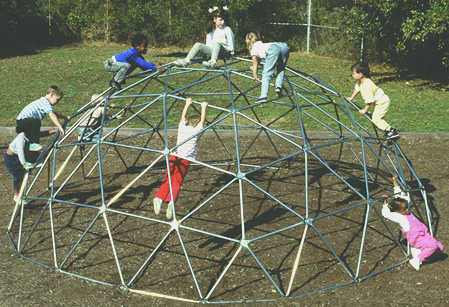
Image curated at skyennis.top.
The Dive was something Erich came up with. It was just what you would think it is—based upon its title. Since you gained points by going faster and by not touching the bars, why not do both at the same time? So, Erich did. One night, he just put his hands together above his head as he lept forward, like an athletic swimmer off the high-dive, and shot through one of the openings, then tucked-and-rolled inside the dome-cage to the other side—and hit it. But still… It was cool. I never quite got the hang of The Dive. However, I could low-crawl though it pretty slick. We each had our strengths.
The rest of the playground stuff was pretty straightforward: If the intended use was to transport down, we went up it. If it was meant to move you, we tried to not fall off it while standing on it or walking over it. We just looked at it, and said things like, “Well, it’s a pole.” “Yup.” “You slide down it.” “Yeah…” “Bonus points for climbing it?” “yeah, okay.”
At this point, some of you may be thinking, “This doesn’t really seem like that Parkour stuff that I watch on the internet. They use buildings and stuff.”
I hear you. Well, so did we.
The covered pavilions had picnic tables with benches. They also had metal pole rafters. And large brick bar-b-que pits, with chimneys, in the center of each structure. We would leap from tabletop to tabletop, swing from the rafters, do a pullup-and-over those same rafters, and kick off from the bar-b-que chimneys to change directions. We would have alternating over-unders from one end to the other (the over-under is where you would have to go over one rafter and then under the next one, only stepping on the table tops). And, if you screwed up and mistook your next move you could either find yourself falling to the hard cement, or stuck hanging without momentum and have to start all over again.
Many a Friday or any Summer’s night, Erich and I would train. We ran those impromptu courses over and over. Constantly improvising. We even got to the point where the timer was an antagonist—a chaser, an ‘It’. The runner just had to run while the chaser followed and threw weapons—or other things—at them, all in an effort to make us want to be better. Faster. Think multiple steps ahead—with alternate routes in case something went wrong. In the beginning, I had an advantage: My ballet training. With that background, I moved pretty quickly and had excellent balance. By the end, Erich had developed a good one: Fearlessness. Erich became bold and unafraid of what might be. He just did. It was pretty awe-inspiring.
Over the years I would utilize those developed skills in other ways. While at Boy Scout Camp, there were plenty of opportunities to move around the mountains. Up and down the slopes, usually at high speeds—we had Friday games where the Boy Scouts would hunt the staff for points. During this time I was asked how I moved so quickly and confidently down those treacherous inclines. It was all those years of Superhero Training (what you would call Parkour, before it was called Parkour). All those years of predicting movements and potentially negative results. However, I called the mountain movement thing Mountain Goating. Because mountain goats move quick and agile over uneven, hilly terrain. Parkour… Phfftt… Silly. It’s Mountain Goating (trademarked). (I know what I wrote)
Yeah, so, you don’t have to believe me. That’s fine. You can think that Parkour was developed in France, sometime in the ‘90s, but I know better. I know it started in a small town park, in the United States, in 1988, by two wanna-be superheroes, that kept it a secret because who goes around blabbing to people that they’re superheroes and giving away their trade secrets and secret identities? Oh, wait…
Hey, um… Can you keep a secret?

 Almost Heroes